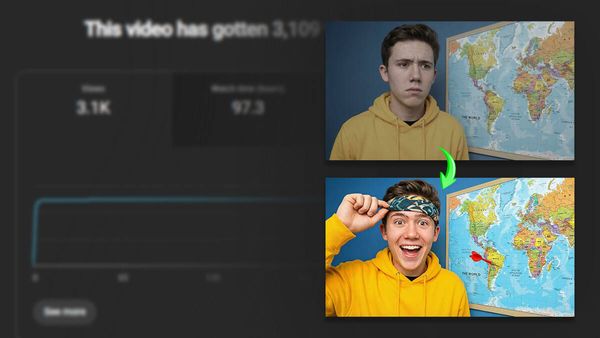
If your videos are getting impressions but not being clicked, the problem usually doesn’t fall on your editing, your posting schedule, or even the algorithm hating your channel.
It’s your packaging that’s the problem.
On YouTube, the title and thumbnail are the decision point.
These are the pieces that shape the first impression your viewer has of the video, why it matters, and whether or not it’s worth their click.
If that package is weak, even a strong video can sink into the depths of YouTube and fail in the algorithm.
Alternatively, if that package overpromises, you’ll get clicks fast, but they’ll die fast and hurt performance anyway.
That is why creators looking to fix YouTube CTR with a custom title and thumbnail are usually asking a deeper question:
How do I make the right viewer choose my video without resorting to cheap clickbait that drives them away anyway?
What Low YouTube CTR Actually Means
CTR, or click-through rate, isn’t just a traffic statistic.
It’s a signal of how weak or strong your packaging is.
It measures how often people click after seeing your video on Home, Browse, Suggested, or Search.
If impressions are coming in and clicks aren’t, YouTube is already giving you a chance.
What this means, however, is that your packaging isn’t converting that chance into action.
People are seeing it and choosing to click away.
A low CTR usually points to one of a few issues:
- The title is flat or over-explains the video
- The thumbnail looks polished and professional, but communicates nothing
- The promise is vague and confusing
- The angle is weak
- The package is attracting the wrong audience
It’s a complex system, and this is why creators get frustrated.
They see the impressions pouring in and assume the content must be bad.
Sometimes that’s true, but more often than not, it isn’t.
Often the video itself is solid, but the framing doesn’t land fast enough and doesn’t connect with the viewer or user avatar you’re trying to reach.
That matters because viewers don’t spend 20 seconds studying your thumbnail.
They make a split-second judgment.
If the idea isn’t clear in their head, they move on.
The Most Common Reasons Your YouTube CTR Is Stuck
I’ve worked with creators for over seven years now.
A lot of YouTubers will keep tweaking the colors, swapping fonts, or rewriting a title a hundred times after uploading.
Usually, however, that misses the real issue.
Your Title Explains the Video Instead of Selling the Idea
Many weak titles may be technically accurate, but strategically they fail.
They read like summaries of the entire video, chasing keywords and telling the viewer exactly what happens without creating any tension, contrast, or payoff.
If you dump the entire answer from your video on the screen, then your title has failed.
A title shouldn’t do this.
It should frame the idea in a fresh way that makes the right viewer need to see the next piece.
The viewer needs to know.
The viewer needs to want the payoff.
Your Thumbnail Repeats the Title
Keep in mind, every word on YouTube is precious.
If the thumbnail and title say the same thing, you’re wasting space.
The thumbnail shouldn’t duplicate.
It should add context, contrast, tension, and emotional weight to the title.
The title and thumbnail work best as a team, when each piece carries a different part of the full promise.
One makes the viewer stop and look at the video more carefully.
The other sells the click.
Your Packaging Attracts the Wrong Avatar
More clicks aren’t always better clicks.
Some of the biggest videos that have gone viral have failed for this exact reason.
If your packaging is broad, vague, or misleading, you may get curiosity clicks from people who are never a fit for the content or for your YouTube channel in the long run.
Usually when I refer to a user avatar, this is what I’m talking about.
You need to find a viewer who will want to watch your channel—not just one video, but all of your content.
If your packaging is misleading and your viewer leaves, then retention drops, satisfaction drops, and even though the video initially seemed to be doing well, it ends up stalling.
Good packaging helps the right audience self-select.
That’s the golden rule.
The Title Promises One Thing and the Thumbnail Promises Another
If you’re giving mixed signals in any situation, not just YouTube, it kills trust.
That’s especially true when you’re trying to sell something.
If the title feels educational but the thumbnail looks dramatic or clickbaity, or maybe the title suggests one outcome while the thumbnail hints at a completely opposite one, viewers will hesitate.
Confusion isn’t clever.
Instead, it lowers CTR fast.
You Change the Design but Not the Positioning
This is a very common trap.
A lot of times when YouTubers make modifications to their thumbnails, it’s because they think the thumbnail just isn’t popping, so they redesign it.
Then they redesign it again and again.
But every time it doesn’t work, and that’s because the real problem might be the angle itself.
No amount of contrast, red arrows, or new reaction faces can fix a weak angle.
The strategy is far more important than the actual design.
Why Custom Title and Thumbnail Packages Outperform Generic Design Services
A lot of thumbnail services, especially on freelance platforms, are built around aesthetics.
You see the listing and the thumbnails on it look good.
They promise eye-catching graphics, bold text, strong colors, and professional polish.
That’s all fine, but design alone doesn’t fix a weak click decision.
A custom title and thumbnail package does more than just make things look better.
It understands the psychology behind YouTube and treats the title and thumbnail as one system—a team built around audience judgment.
That means asking better questions first:
- What’s the strongest angle in this video?
- What’s the real payoff for the viewer?
- What tension or curiosity already exists in the audience’s mind?
- What can be shown immediately?
- What should be withheld until the viewer clicks?
In most cheap YouTube packaging services, that’s the gap.
They optimize for style, not strategy, and not clarity.
Because of this, even though the thumbnails look professional, they end up doing nothing and achieving no results.
What a Strong YouTube Title and Thumbnail Package Actually Does
If you package your YouTube video accurately, it makes the premise understandable almost instantly.
It’s not cluttered, overloaded, or vague and confusing to the viewer.
It needs to give the viewer just enough clarity to know what the video is about and more than enough curiosity to want the answer.
That balance matters.
If there’s no intrigue, the video will feel skippable.
If there’s too much mystery, the viewer might not trust it.
Another very important thing good packaging does is avoid the clickbait retention trap.
Lying about the contents of the video or what the video is about creates curiosity, but it doesn’t deliver.
Good packaging raises a question that the video will genuinely answer.
That’s the difference between manipulative packaging and effective packaging.
One chases the click.
The other chases the click, finds the accurate user avatar, and aligns the click with the content payoff.
If it’s done well, this improves more than CTR.
It also improves your audience fit.
The wrong viewers—the wrong user avatar—will scroll past it.
The right viewers, however, click, watch, and subscribe.
Signs You Need Help With Titles and Thumbnails, Not More Uploads
A lot of creators, when their videos perform poorly, respond by posting more.
Usually, that’s the wrong move.
You likely need better packaging if:
- Your videos are getting impressions but your CTR stays low
- Your strongest videos underperform weaker ones
- You keep rewriting titles after publishing
- You test thumbnails randomly instead of with a clear angle
- You know your niche but struggle to make the idea feel clickable
These are not content volume problems.
These are problems with framing and how you actually sell your content.
What Goes Into a Custom Title and Thumbnail Package?
A real, high-quality custom title and thumbnail package should start before the design.
It starts with strategy.
Topic Angle Review
First, it’s always important to identify the strongest premise inside the video.
Not the broad subject of the video or the general niche of the channel, but the specific angle the video sells.
What is the conflict?
What’s the transformation?
What’s the mistake?
What is the thing a viewer would actually care about?
This step matters because weak packaging often starts here, with weak angle selection.
If your strategy isn’t right, then nothing else you do down the road matters.
None of the implementation matters.
Title Development
After this, any quality service should build multiple title directions, not just one default headline.
The goal is to balance clarity, search intent, and click appeal without sounding clickbaity, robotic, or over-explained.
Thumbnail Concept Strategy
From here, I always like to start on the thumbnail.
Any good YouTube thumbnail carries the story visually and fast, with as little text as possible.
An image is worth a thousand words, and this is where you can really prove that.
What image communicates the core question the quickest?
What needs to be visible on the thumbnail, and what should stay hidden?
Should text be used at all?
If so, how little can achieve the same result?
Title and Thumbnail Pairing
This is where most generic services, like the ones you’ll find on Fiverr or Upwork, fall apart.
A strong package decides what the thumbnail says and what the title says so they complement each other instead of contradicting each other or repeating each other.
If you’re just buying one or the other, it rarely works.
To achieve this, you need your title and thumbnail to work together.
Revision Based on Audience Fit
When it comes to YouTube thumbnails, I always like to say that a good thumbnail depends on the niche.
Packaging for a broad entertainment channel isn’t going to be the same as packaging for a finance educator, a political commentator, or a long-form video essay creator.
Any good custom service should account for niche behavior, audience expectations, and pre-established channel branding before going into the design.
Custom YouTube Packaging vs. DIY
So, is it good to try and DIY your own YouTube thumbnail and title?
It’s not bad, but most creators are too close to their own content.
When they package their video, they already know the full backstory.
So they package it from inside the video—and inside the hundreds of hours they spent editing—instead of from the viewer’s perspective.
That often leads to titles that are accurate but dull, or straight-up confusing, and thumbnails that make sense only if you already know the context of what happens in the video.
The problem is the viewer doesn’t know this.
Another very common problem is copying big channels at surface level.
When a creator sees reaction faces, giant text, or a certain editing style and imitates it without truly understanding why it worked for that niche, that specific topic, and that specific audience, it often fails.
Very often, the visual trick or obvious surface-level element is not the real reason it worked.
The real reason is narrative clarity.
How to Tell if a Title and Thumbnail Service Is Worth Paying For
When you’re buying a YouTube title and thumbnail service, don’t buy based on claims like “viral,” “high CTR,” or “engaging thumbnails.”
Instead, you should look for the process.
Can the provider actually explain how they think about audience fit, topic angle, and promise clarity?
Do they build the title and thumbnail so they work together?
Do they talk about avoiding mismatch between click and retention?
If the offer is just clean design or promises of high CTR with no actual proof or strategic logic behind it, you’re likely paying for a highly decorated, polished-looking thumbnail that will get fewer views than the thumbnails you already make.
What Results Can You Realistically Expect?
Better packaging can improve YouTube click-through rate.
It can lead to stronger first impressions, more consistent performance, and fewer wasted impressions.
But there’s a limit.
I always say that no title and thumbnail package can rescue a weak idea forever.
If, in the rare chance, the topic has low demand, or the video simply fails to deliver on its promise, then packaging alone isn’t going to save it.
What it can do, however, is stop already strong videos from being buried by the algorithm and by weak framing.
And for the vast majority of creators, that’s the real problem.
Who Benefits Most From a Custom Package?
So which creators actually benefit from buying a custom YouTube title and thumbnail package?
This kind of work helps creators who already have content that’s worth watching and high quality, but simply don’t know how to sell it.
That includes:
- Creators getting impressions with weak clicks
- Educational channels with solid expertise but poor appeal
- Commentary and entertainment creators fighting crowded feeds
- Established channels that need reliable packaging support at scale
It also helps sharpen your process upstream.
Better packaging forces clearer topic selection, stronger intros, tighter audience thinking, and more consistent channel identity.
This is really why it matters beyond just the design.
YouTube thumbnails aren’t meant to be cosmetic.
They’re meant to be salesmanship and advertising for your YouTube video.
If Your CTR Is Low, Stop Guessing
Low YouTube CTR isn’t random.
It’s a signal that your title, thumbnail, topic angle, or audience match is off.
There’s something that’s not working.
If you want sharper YouTube packaging built around viewer psychology, clearer positioning, and better click judgment, take a look at the creator services at /creators/.